Service Details
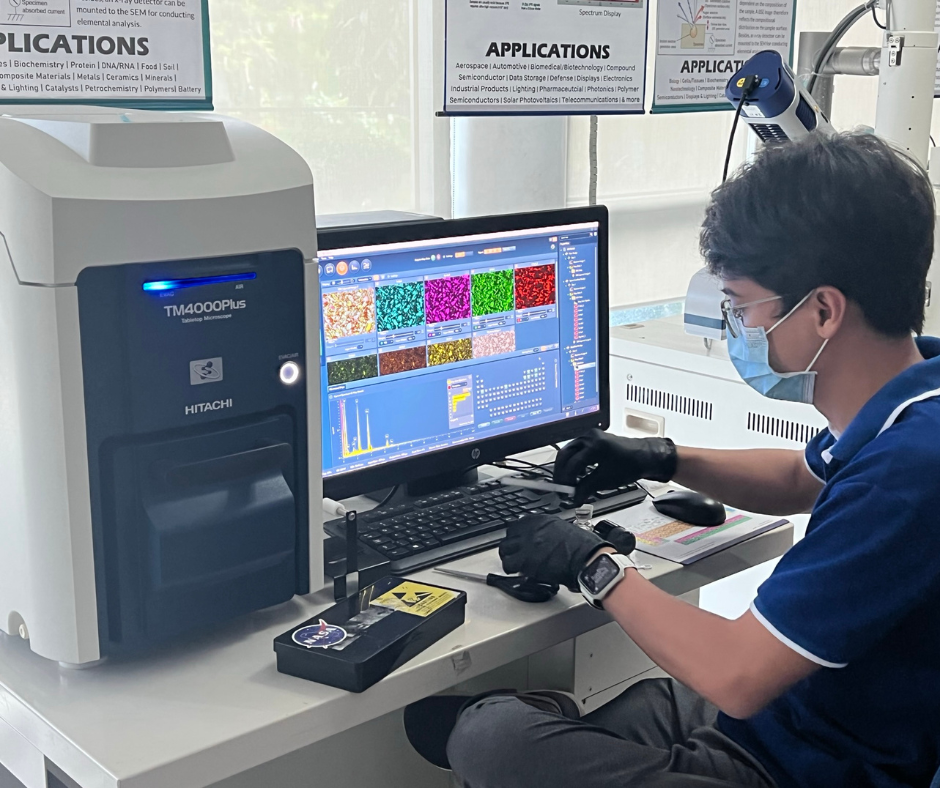
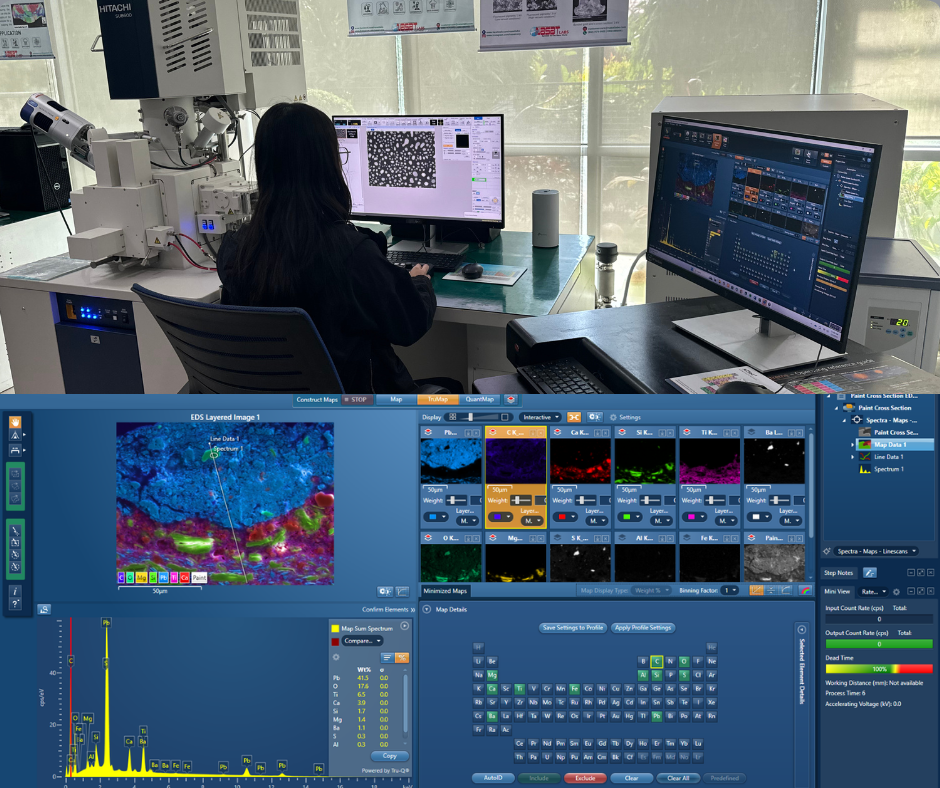
Energy Dispersive X-ray Spectroscopy (EDS or EDX), when integrated with Scanning Electron Microscopy (SEM), enables elemental analysis of materials at the microscale. As the electron beam interacts with the sample, it generates characteristic X-rays that are detected and analyzed to determine the elemental composition of the material.
This technique is widely used for identifying unknown materials, mapping elemental distributions, and supporting failure analysis. It is non-destructive, requires minimal sample preparation, and can detect nearly all elements (except hydrogen and helium). SEM-EDS is applicable to a broad range of materials including metals, ceramics, polymers, and composites.
Common Applications
- Elemental Analysis – Identification of elements present in a sample or area of interest
- Failure Analysis – Investigation of defects, residues, corrosion, contamination, and unusual material behavior
- Materials Science – Composition analysis of metals, ceramics, polymers, composites, minerals, and advanced materials
- Semiconductors & Electronics – Analysis of components, solder joints, particles, coatings, and process-related contaminants
- Particle & Contamination Analysis – Identification of foreign particles, deposits, stains, residues, and surface contaminants
- Coatings & Thin Films – Elemental evaluation of coatings, layers, surface treatments, and cross-sectioned samples
- Research & Quality Control – Material verification, batch comparison, process troubleshooting, and product development support
- And much more.
SEM-EDS is a versatile tool for rapid, localized elemental analysis across research and industry.